

Today is election day in UK, when the citizens of the country choose their new government. You can read all about how the elections work here. You wouldn’t think that dress codes of ancient Rome would affect the elections of today, but they do! Millie Slavidou explains.
Today is a good day to think about the word ‘candidate’. I rather like the etymology of this one.
It comes from Latin candidus, which is the past participle* of candidare, which meant ‘to make white, to make bright’.
Not because of whitewashing whatever the candidates might have said or done! It was because in ancient Rome candidates who wanted to be elected either to the Senate or any other office wore white robes.
If we take it one step further back, to a root meaning ‘white, shining’, we find that ‘candle’ is a cognate.**
*Past Particle
The past particle is the past form of the verb that can also be used as an adjective, like “a fallen tree”. In the case above, the adjective is like saying ‘whitened’ in English. Other examples of past particles are:
verb: bite
past particle: bitten
example: a bitten apple
verb: choose
past particle: chosen
example: aa chosen present
verb: crash
past particle: crashed
example: a crashed bicycle
**Cognates
A cognate is a distant relative, a word ultimately from the same root. Like a third cousin. Here are some examples of cognates.
 Book is related to beech. Well, actually, book means beech! Both come from Germanic word meaning beech tree, Buche.
Germanic runes were originally inscribed on tablets made of beech wood. Modern German for book is Buch!
 WOOL and FLANNEL are distant cognates. Today, fashion stores often describe plaid shirts as ‘flannel’, but it is actually a soft woven fabric, originally made of wool, but now often cotton or synthetic. You might have a flannel pyjamas, which are lovely and cosy in the winter!
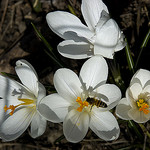
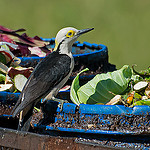 Today’s featured image is Marasmiellus candidus, a type of mushroom. You will often find the word ‘candidus’ used in botany or biology to describe something that is white, such as crocus candidus or the white woodpecker Melanerpes Candidus. There is even a white monkey called Propithecus candidus.