
What is Juno?
There has been a lot of excitement about the Juno probe this week, but what is it and what is its mission?
What is Juno?
Juno is a spacecraft designed and operated by NASA, the US space agency. It was launched from Cape Canaveral on the 5th August 2011 and has taken almost 5 years to travel the 716 million kilometres to Jupiter, the largest planet in our solar system. Juno is 3.5 metres in height, and when its solar arrays are extended it’s more than 20 metres across. These arrays are covered in more than 18,500 solar cells, which allows Juno to operate even when it’s at such a great distance from the Sun.

(Image: NASA)
Why is it called Juno?
In Roman mythology Juno was the Queen of the gods. She was married to the king, Jupiter, who wasn’t always well-behaved. Juno had to peer through the clouds to discover what he was up to; the spacecraft is called Juno because it will be looking beneath the clouds that cover the surface of the planet Jupiter.
Aboard the Juno craft are 3 models of Lego minifigures: Jupiter, Juno and Galileo, who discovered in 1610 that Jupiter had moons.

From left to right: Galileo, Juno and Jupiter. (Image: NASA/JPL-Caltech/LEGO).
What is it looking for?
Jupiter is enormous; it’s two and a half times larger than all the other planets in our solar system combined. It’s made entirely of gases and is believed to have no solid surface. The planet rotates at an immense speed, completing one rotation every ten hours, and telescopes have shown us that it has a cloudy atmosphere with colourful spots and stripes. The largest of these, known as the Great Red Spot, is a storm that is several times the size of Earth and has been raging for more than 300 years.

Jupiter. The Great Red Spot is clearly visible. (Image: NASA).
This mission is the first time that humans will be able to glimpse what lies beneath Jupiter’s cloudy atmosphere. The main objective is to understand how the planet formed and evolved, which will give us more information about the formation of gas giants as well as the rest of the solar system. Juno will also measure the quantities of water and ammonia within the atmosphere, examine the magnetic field that surrounds the planet, observe any polar auroras and measure the gravity to see whether a solid core may exist after all.
For more information about the Juno mission you can watch this video from Nasa, and have a look at the Juno mission webpage.
Where Does the Word Candidate Come From?
Today is election day in UK, when the citizens of the country choose their new government. You can read all about how the elections work here. You wouldn’t think that dress codes of ancient Rome would affect the elections of today, but they do! Millie Slavidou explains.
Today is a good day to think about the word ‘candidate’. I rather like the etymology of this one.
It comes from Latin candidus, which is the past participle* of candidare, which meant ‘to make white, to make bright’.
Not because of whitewashing whatever the candidates might have said or done! It was because in ancient Rome candidates who wanted to be elected either to the Senate or any other office wore white robes.
If we take it one step further back, to a root meaning ‘white, shining’, we find that ‘candle’ is a cognate.**
*Past Particle
The past particle is the past form of the verb that can also be used as an adjective, like “a fallen tree”. In the case above, the adjective is like saying ‘whitened’ in English. Other examples of past particles are:
verb: bite
past particle: bitten
example: a bitten apple
verb: choose
past particle: chosen
example: aa chosen present
verb: crash
past particle: crashed
example: a crashed bicycle
**Cognates
A cognate is a distant relative, a word ultimately from the same root. Like a third cousin. Here are some examples of cognates.
Book is related to beech. Well, actually, book means beech! Both come from Germanic word meaning beech tree, Buche.
Germanic runes were originally inscribed on tablets made of beech wood. Modern German for book is Buch!
WOOL and FLANNEL are distant cognates. Today, fashion stores often describe plaid shirts as ‘flannel’, but it is actually a soft woven fabric, originally made of wool, but now often cotton or synthetic. You might have a flannel pyjamas, which are lovely and cosy in the winter!
Today’s featured image is Marasmiellus candidus, a type of mushroom. You will often find the word ‘candidus’ used in botany or biology to describe something that is white, such as crocus candidus or the white woodpecker Melanerpes Candidus. There is even a white monkey called Propithecus candidus.
A Short Story – The White Dove
Dad walks over to me. He’s carrying several slices of bread.
‘Hi, Grace.’
‘Hi,’ I say, giving him a look which I hope he understands means, I am so not impressed with this new pre-birthday arrangement.
Dad doesn’t seem to have noticed my look. I wonder what he’s doing with the bread.
‘For the ducks,’ he says when he catches me staring at it.
I nod and decide not to mention that I am no longer five years old and that feeding the ducks in the park doesn’t exactly excite me anymore.
‘Right,’ I say, as we head over to the pond.
‘So, Grace, how have you been?’
We sit down on the bench next to the willow tree.
When I Met Mary Robinson – Written By You
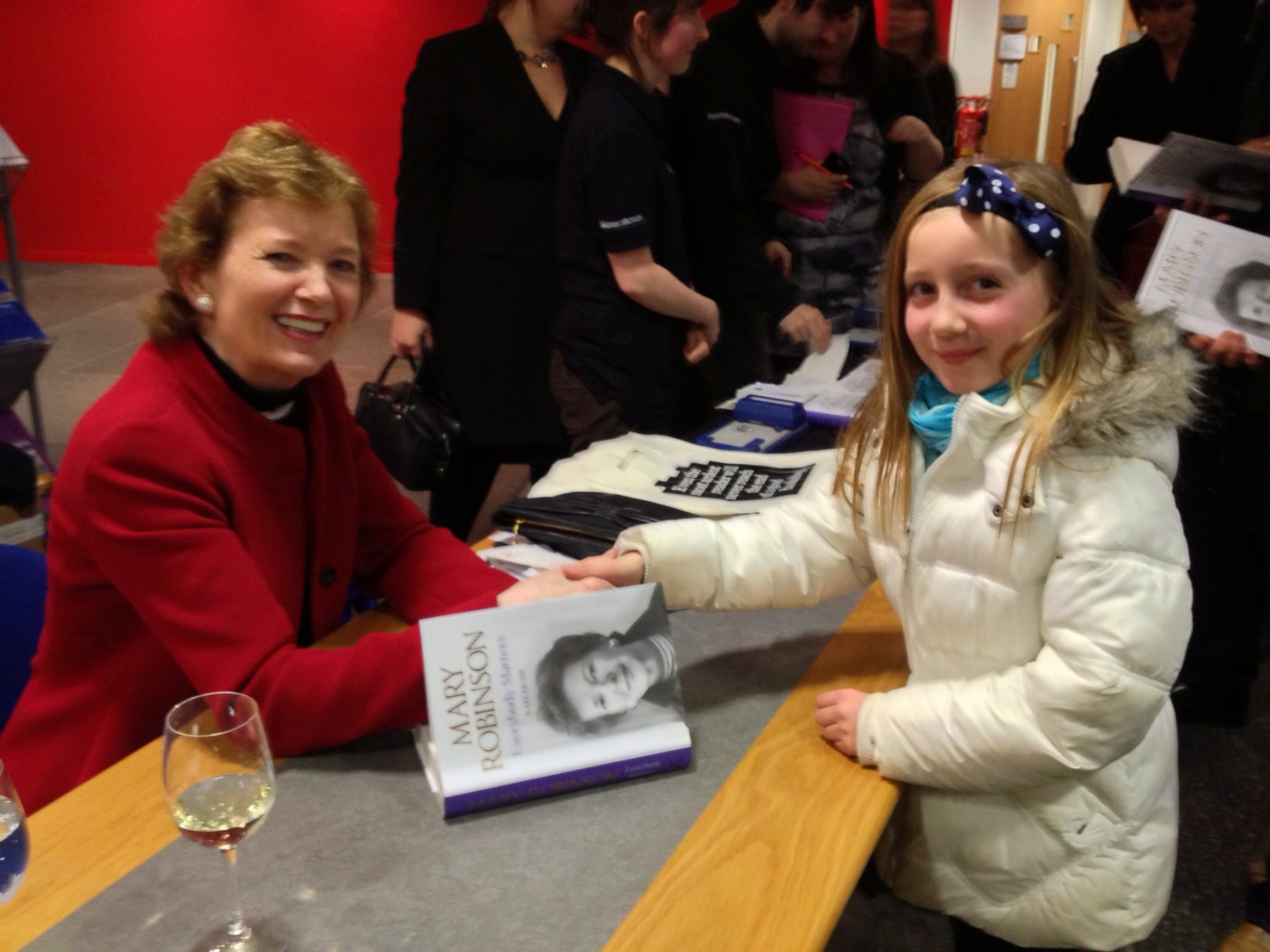
Me and my mum went to hear this lady talk, her name is Mary Robinson, Mary was the President of Ireland, but she was not just any kind of President of Ireland,she was the first woman President of Ireland. She got a Presidential Medal of Freedom from President Obama in 2009. And was the first President of Ireland to visit the Queen.
Growing up
Mary grew up in a small town in Ireland, her mum and dad where doctors and her gran died when she was about 10 years old… When Mary was 17 she went to a finishing school in Paris while deciding if she wanted to become a nun… In that finishing school she was the only non-French speaking student there.
little light
Mary Robinson famously put a light in her kitchen window to guide the people that have left Ireland to live a country abroad back home.
my question
If you had a chance of asking Mary Robinson a question in front of 600 people, would you do it? I would, and I did. Here’s what I said and what Mary replied:

Afterwards Mary signed a copy of her book for me


