Science, Nature and Tech

A Trip to Mars!

Imagine being able to catch a flight to Mars as easily as we travel to another country – that was the idea behind the Trip To Mars session I attended at the Cheltenham Science Festival. It was conducted by Dr Suze Kundu and Dr Simon Foster and presented as a pre-flight safety briefing, with both of them dressed as pilots! There were a lot of humorous moments and sci-fi references but also some great science.

Suze and Simon suggested that in the future, flights to Mars could be far quicker than they are now, and explored how some of the bigger problems could be overcome. For example, the Sun’s magnetic field deflects a significant proportion of the cosmic radiation that could be harmful to humans on Earth; as spaceships travel further away from the Earth and Sun they will have less protection because the magnetic field weakens. To combat this it’s possible that spaceships will contain or be covered with large and powerful magnets, to produce the same deflective effect. This would have the added advantage of also deflecting radiation from solar flares.

Spaceships journeying to Mars would travel at such speed that even tiny fragments of rock and dust could be damaging to the hull. To combat this, and also the heat generated when the spaceship passes through an atmosphere, Suze and Simon discussed the possibility of spaceships being coated in aerogel. This amazing material is a solid formed from silicone dioxide but is 98% air; this means that it is extremely light but also strong. Its melting point is 1,200°C (equivalent to asbestos) and it is a wonderful insulator. Because it consists of large pockets of air between thin layers of silicone dioxide, any dust or rock fragments that hit it would be slowed and stopped before they could penetrate the aerogel completely.

Suze and Simon also discussed the possibilities and problems with cryostasis. Theoretically this is when a person’s body is cooled to temperatures so low that they enter hibernation, ideal for long journeys through space. Unfortunately our technology isn’t advanced enough to do this at the moment; any attempt would result in the cells rupturing and the person dying. But in the future it will be possible, perhaps after the person’s DNA has been altered slightly so that they can produce antifreeze proteins like some species of wasps and turtles.

Read More...

Language & Literature

Should Kids be Taught the International Phonetic Alphabet?

Have you ever flicked through a dictionary to find a word, and then noticed that right next to it there is a set of symbols, some of which resemble the letters you are used to using, but some of which are completely different?

These symbols are there to give you a guide to how the word is generally pronounced, and they are part of the International Phonetic Alphabet, or IPA.

Read More...

Written By You

A Short Story – Concrete

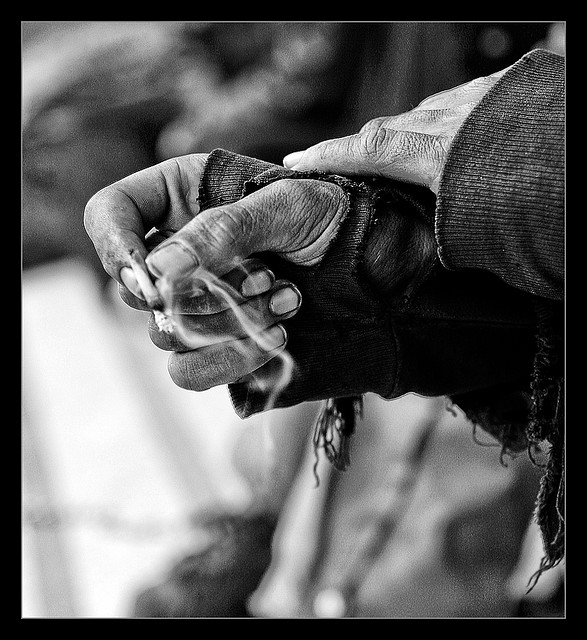
Cold, rough concrete beneath my burnt yellow hands, ash under my nails. I hold the butt of an already smoked cigarette in my mouth, looking hopeless. Not even the phrase, “Any spare change?” will get anybody to notice me, the old tramp of Brixton, sitting on the side of a busy main road. Every day I get unhelpful comments from young school kids, such as, “The local druggie! Ha, ha, ha…” These don’t make me feel better. It’s not my fault I’m unemployed, homeless and either drunk or high most of the time. Or is it?

People ask me how on earth I find all the money to buy over fifty cans of beer a week and a rather large variety of harmful grasses from drug-dealers. Sometimes I wonder too. I’ve only ever stolen something once. Twice then. OK! I’ve stolen eight times! Where else am I supposed to get money from (not including vulnerable children’s purses)? But, I’ve been thinking… Maybe, just maybe, it would be a slight possibility – just a slight one – that I could consider starting afresh. By ‘afresh’ I mean a new life in which I give up all my addictions, that are slowly rotting my bones, and make lasting friendships, that won’t break. Ever.

Read More...

Toys and Games

Make Your Own Interactive Story!

Find out how to make your own interactive story with Jump! Mag and storyteller Justine de Mierre. 

Some people think stories are just for little kids, but stories are all around us. We watch them on television, we read them in books – we even listen to them when someone’s telling us about their great weekend!

Stories aren’t just fairy tales, they can be about businesswomen and athletes just as much as about princesses and trolls.  They can even be about princess-like businesswomen and athletic trolls!

So, if you’re planning a get together with your friends why not give storytelling a go? An interactive story is one you can make up on the spot and gets everyone joining in – and it can be about whatever you and your friends are interested in!

Read More...

School & Career

A Day In the Life Of…a Biologist


Ever wondered what being a biologist might be like? No two scientists work days are the same but I’m going to take you through my typical day to give you an idea

7 AM: I get up and eat breakfast (toast and a cup of tea) before travelling to work.

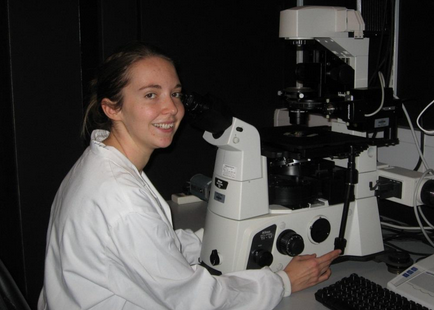
8 AM: I arrive at work (this is early for scientists, most of my workmates arrive at about 9 AM but I like to get up early!) After checking my email the first job of the day is to turn on the microscope above.


Screenshot 2013-11-03 at 17.50.47

The plant root surface is covered in root hairs. This is what they look like under a microscope.To get an idea of the cells, les than 1mm of plant root can be seen in this image

It is similar to microscopes you may have used at school but with a few added features including a special camera. I am fascinated by plants and in my research I am trying to find out more about how some plants (including peas and beans) can form a friendly relationship (known as symbiosis) with soil bacteria, which provide nutrients that the plants need to grow. I use the microscope and camera to study living cells in plant seedling roots (where the symbiosis is set up).


10:30 AM: Tea break and seminar. I have a tea break with some of my workmates and then go to a seminar where other scientists talk about their research and we discuss it afterwards. Seminars are a great way to find out what experiments other scientists are doing, and to get ideas for new experiments to try.


12:30 PM: I have lunch with my friends.

Screenshot 2013-11-03 at 18.00.55

1:15 PM: More experiments. For some of my experiments I have to grow plants in greenhouses. Today I visit to check on my plants and collect some to take measurements. This involves digging up the plants and cleaning them to look at their roots. This is fun, but messy! 

3:30 PM: Afternoon tea break.

3:45 PM: Data analysis. I spend the last part of the afternoon drawing graphs of the data I have collected today and thinking about what it shows (does it answer the research question? Do I need to do further experiments?). I also spend some time reading research articles to find out about experiments other scientists have been doing.


5:30 PM: Hometime! Once I am home I have dinner and then relax.

One of the things I love about being a scientist is the feeling of discovering the “unknown”. The experiments I carry out reveal little details that when combined with other scientist’s data can help us build up a picture of how the plant-bacteria symbiosis is set up so that pea and bean plants can get the nutrients they need to grow. We hope that this knowledge might be able to help improve farming in the future.


About the Author

Sarah Shailes is a plant scientist working at the John Innes Centre, Norwich, UK. She studies how some plants can form a friendly relationship (symbiosis) with soil bacteria, which help the plants gain nutrients they need to grow. When she isn’t in the laboratory she enjoys knitting and hiking, and helps run a local Brownie Guide unit.


Read More...