
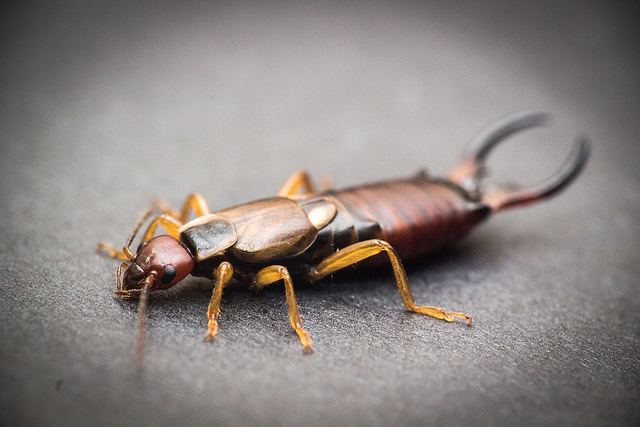
There has long been a myth that earwigs use human ears either to lay their eggs or to live in and feed off our ear wax, or other similar things. It sounds pretty gruesome, doesn’t it? After all, who would actually like the idea of an insect living inside their ear? But do earwigs really live in our ears?
Fortunately for us, it is not true. Despite their name, earwigs don’t actually live in our ears and neither do they use them to lay eggs. They much prefer their normal habitat of nests under rocks and logs or in flowerbeds. So where does the earwig get its name?
Old English Origins
Yet the name itself suggests that this has been a myth for a long time, so let’s examine the name. It can easily be split into two parts: ear and wig. These two parts both come from Old English; which is what we call the language as it was spoken when it was first written down, right up to the tenth century. So this would include the period of Kind Alfred the Great; he of the burning cakes.
In Old English, the words were eare and wicga. The first part, which you can recognise quite easily, meant ‘ear’. But the second part, wicga, meant ‘insect, beetle, worm’. The interesting thing is that it came from a root that did not have anything to do with insects at all, but instead meant ‘wiggle’.
Think about how even today we say ‘wiggly worm’; or think about how you would describe the movement of a caterpillar. You can see how this word came to be associated with insects. So if we put the two parts of our word together again, we have ‘ear-insect’. It seems that our very early linguistic forebears did indeed believe that earwigs lived in the ear.
Blame it on the Romans
But where did this myth that they dwell in our ears come from? It is not unique to English; in German it is known as Ohrwurm, or ‘earworm’, and it is the same in Welsh with pryf clustiog; while in French it is perce-oreille, or ‘ear-piercer’.
To find the origins of the myth, we have to go back in time all the way to the days of the Romans. In around 77 CE, Roman naval commander and writer Pliny the Elder published his work Historia Naturalis, or Natural History.
In it he writes about a great deal of the natural world, including insects. It is here that the myth may have begun, as he writes about earwigs getting into the ear. Perhaps he saw one that had happened to go into the ear by chance, much as a fly or a spider might, and jumped to the wrong conclusions.
The Pincer Insect
Other languages have taken the name from the apearance of the insect; in Italian it is known as forbicina, and in Spanish it is tijereta, while Greek has ψαλίδα [psalida] All three of these translate as ‘little scissors’, deriving from the pincers that the earwig uses to catch its prey.