
Travel

How to Stay Safe at the Beach

Although beaches are fun places they can also be dangerous, and you may have heard some stories in the news lately about people getting into difficulties when they’re in or by the sea. Our science editor Sam Gouldson, who lives on the Sussex coast, shares her tips for beach safety.

Go to a Beach with Lifeguards

lifeguard sign


Many beaches have lifeguards, who are trained to keep people safe whether they’re on the beach or in the sea. You can find out where these beaches are by searching the Good Beach Guide (for the UK), Irish Water Safety (for Ireland) or the ILSE (for Europe). Find out more about the RNLI Lifeguards in UK here.

Pay Attention to the Flags
Beach Safety

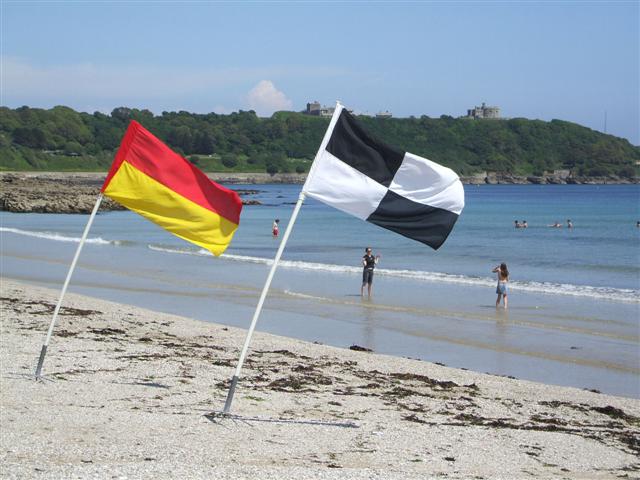
Beaches in the UK use a flag system to inform you of possible hazards. If there are red and yellow flags this means that there are lifeguards in that area and that it’s safe to swim.

A black and white chequered flag means that the area is for people using paddleboards, surfboards and kayaks, and that you should not swim there.

A red flag means that the area is dangerous and you should not go into the water for any reason. There may also be information boards and signs at the beach, and you should read these thoroughly.

Stay With Your Group

beach safety

If you stick with your family or friends you can all keep an eye on each other. Find somewhere distinctive to use as a base while you’re at the beach and agree where you’ll meet up if you get separated.

If there are younger children in your group make sure they’re with a responsible adult or older teen. Some beaches have a wristband scheme so that children can be easily identified and their group members contacted if they wander off; if the beach you’re visiting has one of these schemes, take part.

Learn About the Sea

beach safety

Different beaches have different conditions. The tide can come in much faster at one beach than at another, and you should always keep an eye on the water and which direction it’s flowing in. You can look up tide tables online so that you’re aware of when the tide is likely to turn and don’t get cut off from the shore.

Some beaches have dangerous features called rip tides, which are strong currents that can quickly sweep you out to sea without warning. Always check with the beach’s lifeguards if there are any areas that you should avoid – many beaches have a noticeboard to inform visitors about the current conditions.

Waves can also be dangerous, depending on how fast the water is moving and how steeply the beach shelves. Some beaches will have sharp rocks or other hazards that may not be clearly visible from the shore. Again, check the lifeguard’s advice before you go into the water.

If the weather is cool, consider wearing a protective suit to keep you warm in the water, as cold water shock can affect your breathing, blood pressure and heart rate.

Be Careful When Using Inflatables

photo-1422050383214-11e20f3f1d65

Inflatable toys and beds are designed to be used in swimming pools, not on open water. But if you do use them make sure there is an adult with you and that you’re in the lifeguarded area between the red and yellow flags.

You should stay near the shore and never use inflatables when there are big waves or an windsock is flying; these are signs that the wind is too strong.

Know What to Do If You Get Into Trouble

A photo by Pierre-Olivier Bourgeois. unsplash.com/photos/gfctvxvyvLk

If you find yourself in difficulties, stay calm. If the water is shallow enough for you to stand, wade through the water instead of trying to swim in it. Raise at least one hand in the air and shout loudly and clearly for help, and don’t try to swim against the tide because you’ll just tire yourself out.

If you have a board or an inflatable hold onto it; not only will it help you stay afloat it will also make you easier for rescuers to spot.

If you see someone who is in trouble in the water, stay calm. Alert the lifeguards, or if you can’t see them call the emergency services on 999 (in the UK) or 112 (anywhere in Europe).

Stay Safe in the Sun

photo-1458530553242-34a1bdf98213

Although the sea can be dangerous, so too can the sun. Always use sunscreen with a sun protection factor (SPF) of at least 30, and re-apply frequently.

Keep your head and shoulders covered, wear sunglasses to protect your eyes and stay in the shade at the hottest part of the day (usually between 11am and 3pm).

For more information read “Why is too much sun bad for you and how does sunscreen work?”.

Read More...

Art & History, Popular

Early English Writing – Runes and the Futhorc

runes

Did you know that English hasn’t always been written using the alphabet that we know today? There have been several changes in the way we write over the centuries. We shall start by looking at the runic script. You may already have heard of runes, and perhaps you know that the term refers to some form of writing. We’ll look at runes and the early English alphabet called Futhorc. 

Runic Script

First of all, what are runes? Contrary to what legend and hazy modern stories may tell us, runes are not magical, and they are not an exclusive part of an ancient Celtic religion or only associated with druids. Neither are they symbols of the mysterious or spiritual. It is very simple. Runes are letters.

Runic script is a system of writing that is surprisingly close to what we use today in its concept: runes are the letters in a set of alphabets (sometimes called ‘runic alphabets’). These alphabets were used to write Germanic languages. Not simply German as we know it today, but other languages in the same family. This means that it includes English. In fact, the earliest form of writing for English was runic.

The very early form of English that evolved from a language we call Proto-Germanic, which we believe gave rise to many other languages such as German, Dutch, Swedish and others, is known by the term Old English and sometimes also Anglo-Saxon. The second term reflects the names of the Germanic tribes which are believed to have formed the main group of speakers that arrived on the British Isles to displace Celtic languages. It is this early form of English, Old English, which was written in runes.


The Futhorc or Fuþorc

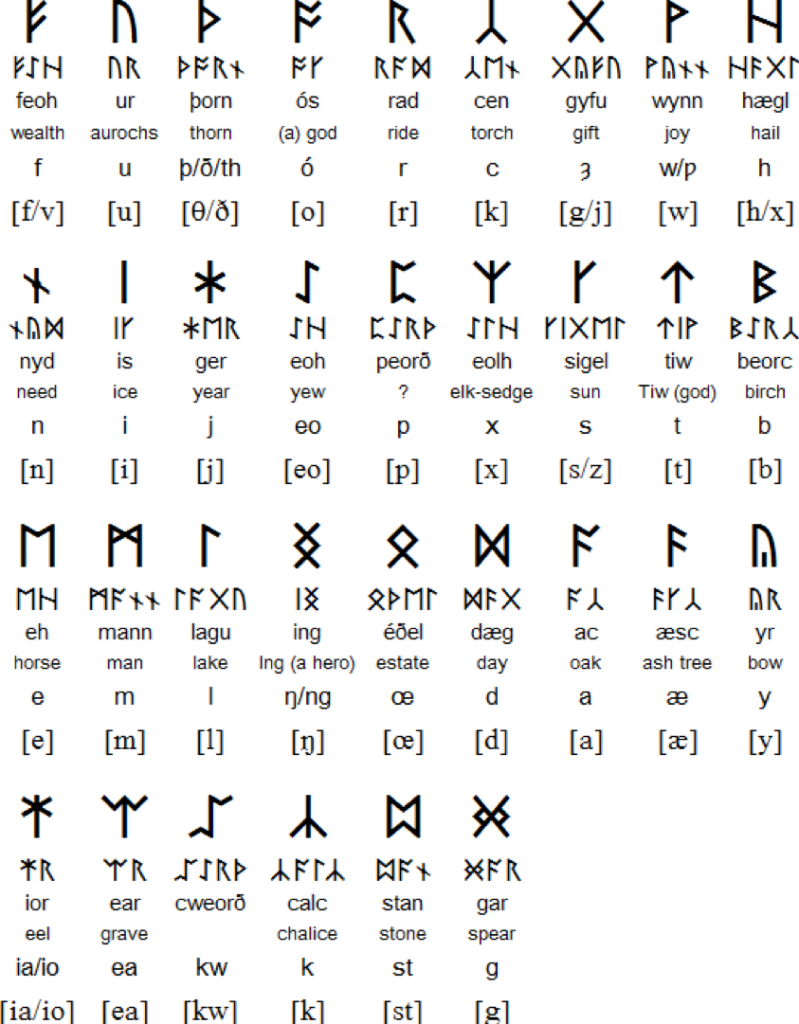
The version of runes used to write Old English is known as the Futhorc. It was developed from the older system of runes used to write other, earlier West Germanic languages, known as the Futhark (fuþark). This Futhark consisted of 24 runes, and the early English speakers found it necessary to expand that and add extra runes to reflect the changes in pronunciation, or the sounds that gradually became part of the language. 

They started by adding two extra runes, and this gradually increased until the Futhorc consisted of as many as 33 runes, or letters. You may be thinking that this is rather a lot – but then consider that our modern alphabet uses combinations of more than one letter in order to represent one sound, such as ‘th’ or ‘sh’ and so on. The Futhorc has a separate letter, the thorn þ, to represent ‘th’. 

Now, in modern English, we use the Latin alphabet with a few modifications to write our language. The Latin alphabet was first adapted from the Etruscan alphabet, which was in turn derived from the Greek alphabet, and this is where we get its name from.

We call it ‘alphabet’ from the first two letters, A and B, which in Greek are alpha and beta: alphabet. So what about this ancient runic system? Where does the name ‘futhorc’ come from?

There is nothing mysterious about it. It is not an arcane word with some sort of symbolic meaning requiring years of study to understand. When we break it down, it is the same idea as the alphabet. The name ‘futhorc’ derives, or comes from, the first six letters of the runic alphabet. These are feoh (F), ur (U), thorn (TH), os (O), rad (R) and cen (C); FUTHORC, as you can see.


It is essentially the same concept as the alphabet that we use today: each rune, or letter, was used to represent a phoneme, or sound, the basic building blocks of our words.

The Futhorc was used for several centuries to write down English, and for a while when the Latin alphabet was first used for English, the two were both in use at the same time. You can even see some early monuments which have both systems of writing side by side!

Runes were used from around the fifth century to the ninth or tenth centuries in English, although the Germanic Futhark is much older than that.

In our next post, we’ll take a look at the Latin Alphabet, and tell you where you can go to take a look at RL examples of the Futhorc and the Latin Alphabet.

SaveSave

SaveSave

SaveSave

SaveSave

SaveSave

SaveSave

Read More...

Art & History, School & Career

Girls Don’t Need No Education

‘WHAT?!’,I hear you cry. ‘Of course we need education!’ And you are absolutely correct.
Sadly in some areas of the world, this is not seen as a basic human right. Children, especially girls, are denied access to schools.
I am sure you have all heard of Malala Yousafzai, the young education campaigner from Pakistan who was shot by people who do not agree with her campaign for girls to be educated.
Malala is carrying on a fight for education that other countries have already fought and won. Tina explains how girls in her home country, United Kingdom, were once forbidden from going to school and when this changed.

Read More...

School & Career, Science, Nature and Tech

What is the Point in Learning Chemistry?

learning chemistry

Have you ever sat in a Maths class wondering why you will ever need to be able to do long division without a calculator? Or silently cursed your Geography teacher while learning about the formation of oxbow lakes? And History?
That’s all in the past and irrelevant, isn’t it? In this series of articles we will look at some of the subjects we learn at school, and try and answer the question: What’s the point in learning… Chemistry?

Read More...